Over seven million Americans have Alzheimer’s, and nearly 12 million family members provide care to loved ones facing cognitive challenges.
These caregivers carry tremendous responsibility, with 83 percent of help provided to older adults coming from family members. Perhaps most striking: about 30 percent of these caregivers are age 65 or older themselves.
When cognitive decline progresses, families face difficult decisions about care options. Many assume that putting a parent with dementia in a nursing home represents the only choice. However, understanding the differences between memory care and nursing homes reveals important distinctions that dramatically affect quality of life, daily experiences, and how individuals with dementia thrive.
This guide clarifies what memory care actually provides, how it differs from traditional nursing facilities, and why specialized dementia communities offer advantages many families don’t realize exist.
At StoneCreek of Flying Horse Senior Living, we help families navigate these decisions with clarity and compassion, ensuring you find care that honors your loved one’s dignity while providing the specialized support cognitive challenges require. Let us simplify your journey to Alzheimer’s and dementia care.

Understanding Memory Care Communities
Memory care provides specialized residential support designed specifically for individuals with Alzheimer’s and other forms of dementia. These communities create secure, structured settings where trained care teams understand the unique needs of those experiencing cognitive impairment.
What Memory Care Provides
- Intentionally-built living spaces, preventing wandering while allowing freedom of movement within secure boundaries
- Higher staff-to-resident ratios for personalized attention
- Care teams with specialized dementia training
- Purposeful daily programming
- Sensory activities evoking positive memories
- Simplified layouts with visual cues aiding navigation
- Consistent routines providing comfort and predictability
- Family support groups and educational resources
Memory care bridges the gap between standard residential living and intensive medical facilities. Residents receive comprehensive assistance with daily activities while participating in meaningful programming designed to maintain abilities, reduce anxiety, and support emotional well-being.
Unlike general care settings, memory care communities focus entirely on creating spaces and experiences that honor how individuals with cognitive challenges experience the world.
Understanding Nursing Homes
Nursing homes provide long-term residential care for individuals with complex medical conditions requiring round-the-clock nursing supervision. These facilities serve people whose health needs exceed what other care settings can accommodate.
Nursing Home Services Include
- 24-hour medical supervision by registered and licensed practical nurses
- Complex wound care, IV therapy, and feeding tube support
- Custodial care for bedbound residents
- Access to specialized healthcare professionals
- Medication management and health monitoring
- Palliative and hospice care
Some nursing homes with memory care offer specialized dementia units within larger facilities. However, the primary focus remains on medical management rather than cognitive support and dementia-specific programming.
The difference between memory care and a nursing home centers on specialization. Nursing facilities address broad medical needs across diverse populations. Memory care communities exclusively serve those with cognitive challenges, tailoring every aspect of care to dementia-specific needs.
Do All Forms of Dementia Need Memory Care or Nursing Homes?
Dementia is a collection of symptoms that affect memory, thinking, and daily functioning. Multiple types exist, each progressing at a different rate.
Most Common Forms
- Alzheimer’s accounts for 60 to 80 percent of cases. Progressive memory loss typically begins gradually, advancing through predictable stages over years.
- Vascular dementia results from reduced blood flow to the brain, often following strokes. Symptoms may appear suddenly and progress in steps rather than gradually.
- Lewy body dementia causes fluctuating cognition, visual hallucinations, and movement difficulties. Individuals experience good days and challenging days unpredictably.
- Frontotemporal dementia affects personality, behavior, and language more than memory initially. Individuals may exhibit inappropriate social behavior or language difficulties before significant memory loss appears.
Not all individuals require memory care or nursing home placement initially. Many live at home with family support during the early stages. However, as cognitive decline advances, specialized care becomes necessary for well-being and family caregiver sustainability.
Understanding Dementia Stages and Caregiver Realities
Recognizing how dementia progresses helps families anticipate needs and plan appropriately.
Early Stage
Memory lapses occur occasionally. Individuals may forget recent conversations or misplace items, but remain largely independent. Families provide gentle reminders and assistance with complex tasks, such as finances.
Middle Stage
Changes become more pronounced. Individuals need help with daily activities, including dressing, bathing, and meal preparation. Confusion increases, wandering may begin, and personality changes emerge. Behavioral challenges such as agitation, repetitive questioning, and sleep disturbances appear.
Family caregivers face increasing demands. What began as occasional help becomes nearly constant supervision.
Late Stage
Individuals require comprehensive assistance with all daily activities. Communication becomes difficult, mobility decreases significantly, and awareness of surroundings diminishes. Medical complications, such as swallowing difficulties, may arise.
When Care Exceeds Family Capacity
Many families reach a point when it is time for a nursing home dementia placement or memory care becomes apparent. Signs include:
- Caregiver exhaustion, affecting their own health
- Inability to manage behavioral challenges
- Round-the-clock supervision needs exceeding family resources
- Wandering is creating concerns about well-being
- Medical complexity requires professional oversight
- Social isolation for both the individual and caregiver
Recognizing when professional care serves everyone best isn’t failure. It’s acknowledging that specialized support allows individuals to thrive while loved ones return to being friends or family members rather than exhausted caregivers.
Key Differences: Memory Care vs. Nursing Homes
Specialization and Training
- Memory Care: All programming, design, and staffing focus on cognitive impairment. Dementia care nurses and dementia specialist nurses receive extensive training in communication techniques, behavioral support, and person-centered dementia care approaches.
- Nursing Homes: Staff address diverse medical conditions. While some receive dementia training, it’s not the sole focus. Dementia and nursing homes may coexist, but attention is divided among various resident needs.
Daily Programming and Activities
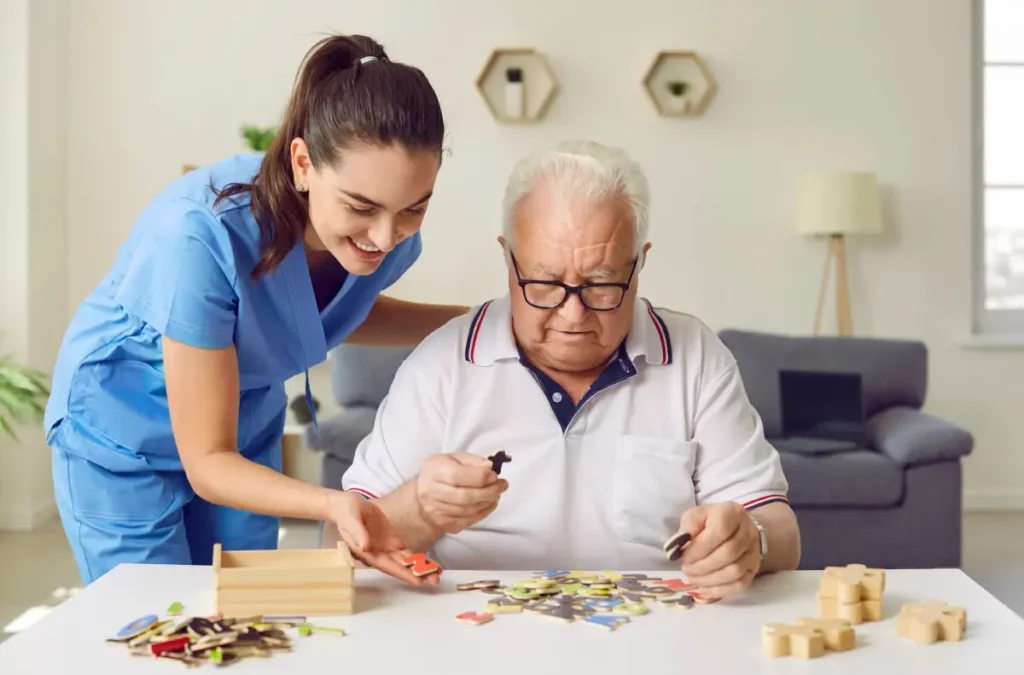
- Memory Care: Activities specifically designed for cognitive abilities. Music therapy, reminiscence programs, sensory stimulation, and activities matching current functioning levels. Programming adapts to how individuals with dementia experience the world.
- Nursing Homes: Limited activity programming. The focus remains on medical care rather than on cognitive stimulation or meaningful engagement.
Living Space Design
- Memory Care: Purposeful design supporting cognition. Color-coded areas, memory boxes, simplified layouts, enclosed outdoor spaces, and visual cues help residents navigate independently.
- Nursing Homes: Clinical settings prioritizing medical efficiency over dementia-specific design elements.
Approach to Care
- Memory Care Communities: Person-centered care recognizing each individual’s unique history, preferences, and remaining abilities. Nursing care plan for dementia development involves families and focuses on maintaining dignity while supporting needs.
- Nursing Homes: Medical model focusing on health management. Nursing management of dementia occurs, but it isn’t the comprehensive, specialized approach memory care provides.
Staff Ratios and Interaction
- Memory Care: Higher ratios allow for individualized attention, relationship-building, and consistent caregivers who understand each resident’s patterns and preferences.
- Nursing Homes: Lower ratios as staff manage diverse medical needs across larger populations.
Understanding the Costs
According to 2024 CareScout data, the cost of dementia nursing home care varies significantly from that of specialized memory care.
Nursing Homes:
- Semi-private room: $9,277 monthly
- Private room: $10,646 monthly
According to A Place for Mom’s 2025 report, memory care costs an average of $6,450.
The lower memory care costs reflect focused specialization rather than comprehensive medical facilities. Families often discover that memory care or nursing home decisions aren’t purely financial but rather about appropriate care levels and quality of life.
National data shows that 44 percent of assisted living residents have some form of dementia, yet only 18 percent of communities have designated dementia care units. An additional 11 percent serve exclusively those with cognitive challenges. This gap reveals why finding communities designed specifically for dementia matters tremendously.
How to Choose Between Options
Several factors determine whether memory care or a nursing home best serves your loved one.
Consider Memory Care When:
- Primary need is dementia-specific support rather than intensive medical care
- Individuals benefit from structured routines and cognitive programming
- Behavioral challenges require specialized dementia training
- You want a community designed entirely around cognitive needs
- Higher staff interaction and personalized attention matter
Consider Nursing Homes When:
- Complex medical conditions require 24-hour nursing supervision beyond dementia support
- Individual needs feeding tubes, IV therapy, or intensive wound care
- Advanced dementia nursing home or memory care decision hinges on medical complexity
- Multiple chronic conditions require coordinated medical management
For most individuals with dementia who don’t have significant medical complexity, memory care provides more appropriate specialized support than general nursing facilities.
Alternatives to Nursing Homes for Dementia
Families researching alternatives to nursing homes for dementia should know that multiple options exist:
In-Home Care: Professional caregivers provide support at home. Works well during early to middle stages, but becomes challenging as needs increase.
Adult Day Programs: Provide daytime supervision, activities, and respite for family caregivers while individuals return home in the evenings.
Respite Care: Temporary stays in dementia care communities give family caregivers breaks while loved ones receive professional support.
Memory Care Communities: Full-time residential care in dementia-specific communities with specialized programming, trained staff, and comprehensive support.