Can someone with dementia live in assisted living? What kind of care do dementia patients need daily? For families in Louisville and surrounding Kentucky communities researching care options, understanding how dementia support works helps match services to actual needs.

While searches often use the term “dementia assisted living,” these specialized programs are more commonly called memory care. The distinction matters because standard assisted living provides personal care support for daily activities, while memory care offers dementia-specific programming, trained teams, and protected spaces designed for cognitive challenges.
Over 7 million Americans have Alzheimer’s, and Kentucky data reveals that nearly 4,000 assisted living residents call the state home, with 32% experiencing some form of dementia. This significant overlap demonstrates why many communities now offer specialized memory care programs.
The question becomes not whether professional support exists, but how memory care provides appropriate assistance while honoring dignity and quality of life.
What Does Memory Care Include?
Assisted living with dementia care, or memory care, provides residential support specifically designed for individuals experiencing cognitive challenges. These programs address needs that standard assisted living cannot accommodate alone.
Core services typically include:
- Personalized care plans addressing individual cognitive abilities and preferences
- Medication management, ensuring proper dosing and timing
- Help with bathing, dressing, grooming, and daily activities
- 24-hour supervision from trained team members
- Structured daily routines providing predictability and comfort
- Cognitive activities supporting remaining abilities
- Protected spaces preventing wandering while allowing freedom of movement
- Family support and educational resources
The structured approach addresses confusion and anxiety common with dementia progression while maintaining residents’ autonomy within appropriate parameters.
How Is Memory Care Different From Regular Assisted Living?
While both assisted living and memory care provide personal care support, specialized dementia programs offer distinct features addressing cognitive decline.
Specialized Training and Expertise
All memory care team members receive extensive dementia-specific training in communication techniques, behavioral support, and person-centered approaches. Regular assisted living teams provide excellent care but may not have the specialized knowledge dementia requires.
Purpose-Built Design
Memory care neighborhoods feature intentional design elements, including protected outdoor courtyards with clearly defined spaces, color-coded areas for easier navigation, simplified layouts that reduce confusion, visual cues to help residents find their way, and memory boxes outside apartments that provide familiar reference points.
Higher Team Ratios
Dementia care requires more individualized attention than general assisted living provides. Memory care maintains higher team-to-resident ratios, ensuring each person receives appropriate supervision and engagement.
Cognitive Programming
Activities specifically designed to support dementia progression help preserve remaining abilities through music therapy, reminiscence programs, sensory stimulation, and purposeful daily routines matched to current functioning levels.
Assisted Living for Couples With Dementia
When one spouse experiences cognitive decline while the other maintains independence, families often worry about separation. Assisted living for couples with Alzheimer’s and dementia allows partners to remain together while receiving individualized support.
Couples’ memory care arrangements include:
- Shared apartments where both partners live together with personalized care plans
- One spouse receiving specialized dementia support while the other maintains independence
- Adjacent residences within the same community allowing daily connection
- Flexible support adapting as needs change without requiring separation
This approach honors decades of partnership while ensuring both individuals receive appropriate care. The spouse without dementia often experiences relief when professional teams handle daily care needs, allowing them to return to being a partner rather than an exhausted caregiver.
Understanding Cost Differences
When comparing assisted living for dementia to standard assisted living, pricing reflects the specialized teams, training, and programming required.
According to current data, assisted living in Louisville averages $5,550 per month, while memory care averages $8,794 per month. This difference reflects intensive team ratios, specialized training, and protected spaces that dementia care requires.
The investment provides comprehensive support addressing both cognitive needs and daily living assistance in purposefully designed spaces where residents can thrive.
Memory Care at The Grand Senior Living
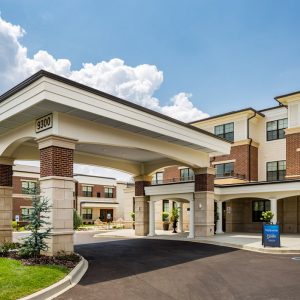
The Grand Senior Living provides memory care in The Cottage, where residents with Alzheimer’s and other forms of dementia maintain dignity while receiving specialized support.
Our approach recognizes that dementia changes how individuals experience the world, and our trained teams adapt communication, activities, and care delivery to honor these differences.
Families discover that professional dementia care often strengthens rather than diminishes their relationships with loved ones. When trained teams handle daily care needs, family members return to being daughters, sons, and spouses rather than exhausted caregivers.
Regular updates, care plan reviews, and educational support help families understand progression while continuing their relationships.
Our memory care neighborhood includes:
- 24-hour care teams with specialized dementia training
- Protected spaces designed for freedom of movement
- Structured daily routines reducing confusion and anxiety
- Cognitive activities supporting abilities
- Personalized care plans honoring individual histories
- Quarterly family care plan reviews
- Visual cues and simplified layouts aiding navigation
- Couples memory care accommodations
Located in Louisville with deep community ties, our multigenerational approach respects family involvement in care decisions while providing compassionate, relationship-driven support.