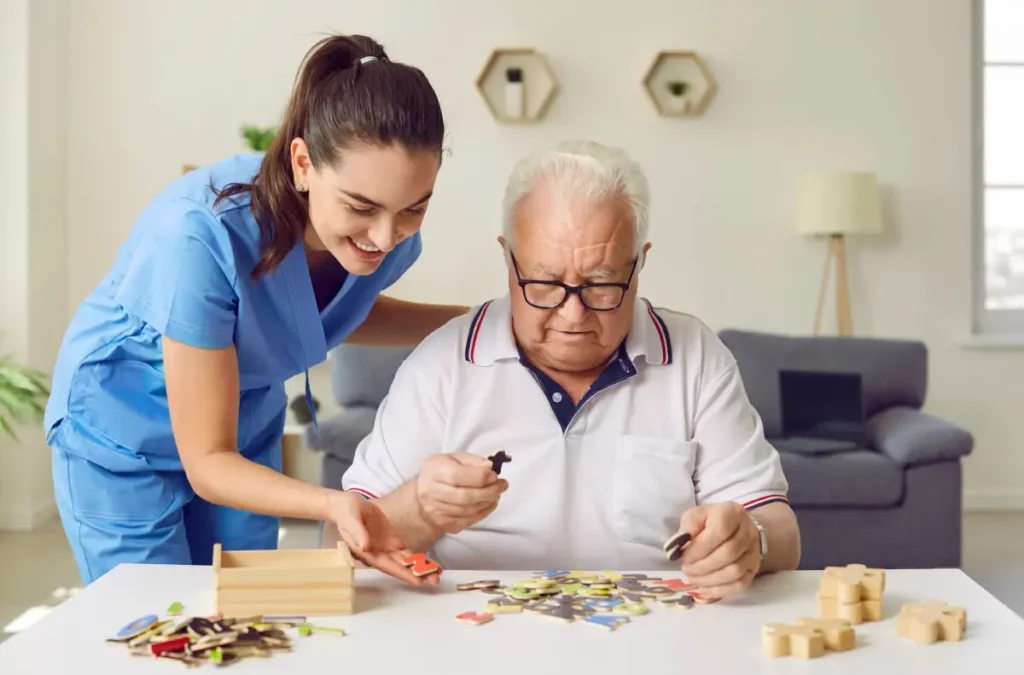
When a loved one starts showing signs of memory loss, families tend to search for answers before they search for solutions. Questions like “Is this Alzheimer’s or dementia?” and “Do they require different types of care?” are often among the first ones asked, and the answers matter before any conversation about a community can begin.

More than 7 million Americans have Alzheimer’s, the most common form of dementia. In Colorado alone, more than 90,000 people experience this, supported by an estimated 211,000 family caregivers, many of whom call Colorado Springs home.
For those families, understanding what Alzheimer’s care actually involves and how much it costs is an essential first step.
What Is the Difference Between Alzheimer’s and Dementia?
Dementia is not a single diagnosis. It is an umbrella term for a group of conditions that affect memory, thinking, and the ability to perform daily tasks.
Alzheimer’s is the most common type, accounting for the majority of diagnoses, but other forms exist as well.
When people search for different types of Alzheimer’s, they are often actually asking about distinctions between forms of dementia. Those include:
- Alzheimer’s, the most prevalent form, is marked by progressive memory loss and cognitive decline
- Vascular dementia, which often follows a stroke, affects thinking speed and problem-solving
- Lewy body dementia, which can cause movement changes, sleep disturbances, and visual hallucinations
- Frontotemporal dementia, which affects personality, behavior, and language more than memory in the early stages
- Mixed dementia, a combination of two or more types occurring at the same time
While each form has its own characteristics, high-quality memory care is designed to support the full spectrum of cognitive conditions rather than a single diagnosis.
How Does the Type of Dementia Affect the Care Someone Needs?
The progression and presentation of dementia can vary depending on the diagnosis, the individual, and other health factors. That is why Colorado Springs Alzheimer’s care should not follow a single template.
What tends to matter most across all types of dementia includes:
- Consistent daily routines that reduce confusion and anxiety
- Team members trained in communication approaches specific to dementia
- Secure neighborhoods that allow freedom of movement within defined boundaries
- Programming designed to meet residents at their current cognitive level
- Personalized care plans that are reviewed and adjusted as needs change
The right community accounts for all of these needs simultaneously, not as separate checkboxes but as an approach to structuring each day.
What Alzheimer’s Care Actually Looks Like Day to Day
Understanding Alzheimer’s care in Colorado Springs means understanding the changes in daily life that occur when specialized support is in place.
For a person with dementia, the challenges extend well beyond memory:
- Mealtimes can become difficult when depth perception and appetite are affected
- Getting dressed may require more time and guidance than it once did
- Social interaction becomes harder to initiate, but no less important for overall well-being
- Anxiety can escalate quickly in unfamiliar or overstimulating settings
Memory care communities address these realities through:
- Structured daily schedules that provide predictability and reduce disorientation
- Dining experiences designed around familiarity and ease of participation
- Activities that connect with residents based on their current abilities
- Team members present around the clock who know each resident’s personal history and preferences
The most telling sign of a well-run memory care community is not what happens during a tour. It is what happens on an ordinary Tuesday afternoon.
Alzheimer’s Care in Colorado Springs at StoneCreek of Flying Horse
For families in the Flying Horse, North Colorado Springs, Monument, and Black Forest areas, StoneCreek of Flying Horse offers memory care through The Cottage, its own distinct neighborhood within the community built specifically around dementia support.
Families who have been managing care at home often describe the same shift after a loved one moves in. The visits change:
- Instead of arriving to manage medications, coordinate meals, and monitor behaviors, they arrive to spend time
- A daughter who dreaded weekly visits because they left her depleted starts looking forward to them again
- A spouse who had not slept through the night in months begins to rest
The Cottage team is trained in Teepa Snow’s Positive Approach to Care, a nationally recognized framework for responding to dementia with patience, skill, and respect for the individual.
Programming draws on each resident’s personal history, including the backgrounds common to Colorado Springs families with ties to Fort Carson, Peterson Space Force Base, and the Air Force Academy.
Care plans are built around the person, not just the diagnosis, and they are updated as needs evolve.